Robotic Knee Replacement
How Dr. Patel uses Mako robotic assistance in total and partial knee replacement, who it may fit, and what it does not change.
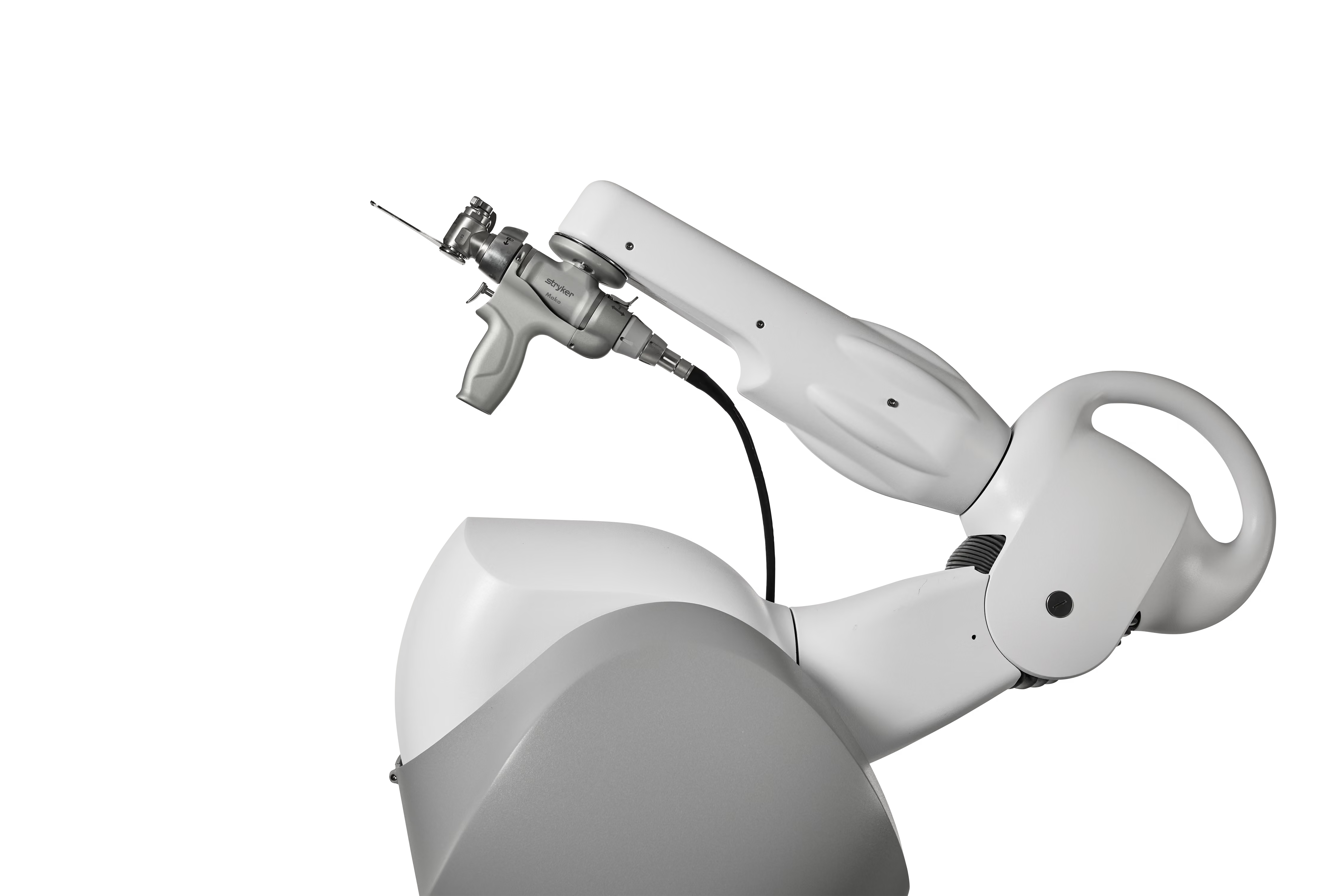
The short answer
Robotic-assisted knee replacement uses a CT-based plan and a robotic arm to support the surgeon’s execution of bone preparation and implant positioning. Dr. Patel performs robotic total and partial knee replacement on the Mako System. The system is a tool under the surgeon’s control; it does not decide who needs surgery.
What the robotic arm actually does
Before surgery, a CT scan of your knee is used to build a three-dimensional plan for implant size and position. The scan is an extra appointment before surgery and carries a small radiation dose, which is part of the tradeoff of choosing robotic assistance. During the operation, the robotic arm helps the surgeon execute the plan, keeping bone cuts within the planned boundaries while the surgeon performs and adjusts the operation in real time.
The surgeon remains responsible for every decision: the plan itself, the balance of the ligaments, and the judgment calls a plan cannot anticipate.
Where it fits in this practice
Dr. Patel uses the Mako System for total knee replacement, for partial knee replacement in selected disease patterns, and in selected revision settings, with nearly a decade of experience on the system across training and practice.
Whether robotic assistance is used in your operation depends on your anatomy, the disease pattern, and the implant plan. The candidacy questions for a total or partial knee come first.
An honest word on evidence
Robotic assistance gives the surgeon patient-specific targets for bone preparation and implant placement, and measures the result against that plan during the operation. Whether that precision translates into better long-term function or implant survival for every patient is still an active area of study, and this page will not claim otherwise.
The right question in consultation is not “is the robotic arm better?” but “what about my knee makes this tool useful, and what would you do differently without it?”
What robotic-assisted knee replacement looks like
This patient-education animation from Stryker walks through how a Mako total knee replacement is planned and carried out. It is a general illustration of the technology, not a recording of any specific operation.
Use the consultation to make the decision clearer.
- Would you use robotic assistance for my knee, and why?
- Does the CT-based plan change my implant choice?
- Is partial knee replacement with robotic assistance an option for my pattern of arthritis?
- What does the robotic arm not change about my operation or recovery?
Sources and further reading
- Total Knee ReplacementAmerican Academy of Orthopaedic Surgeons
- Total Knee ReplacementAmerican Association of Hip and Knee Surgeons
- Unicompartmental (Partial) Knee ReplacementAmerican Academy of Orthopaedic Surgeons
- Total Versus Partial Joint ReplacementAmerican Academy of Orthopaedic Surgeons
- The clinical and cost-effectiveness of total versus partial knee replacement (TOPKAT): 5-year outcomes of a randomised controlled trialThe Lancet (Beard et al., 2019)
- Optimal usage of unicompartmental knee arthroplasty: a study of 41,986 cases from the National Joint Registry for England and WalesThe Bone & Joint Journal (Liddle et al., 2015)
- Lateral Unicompartmental Knee Arthroplasty (textbook chapter co-authored by Dr. Patel)Essentials of Cemented Knee Arthroplasty, Springer, 2022